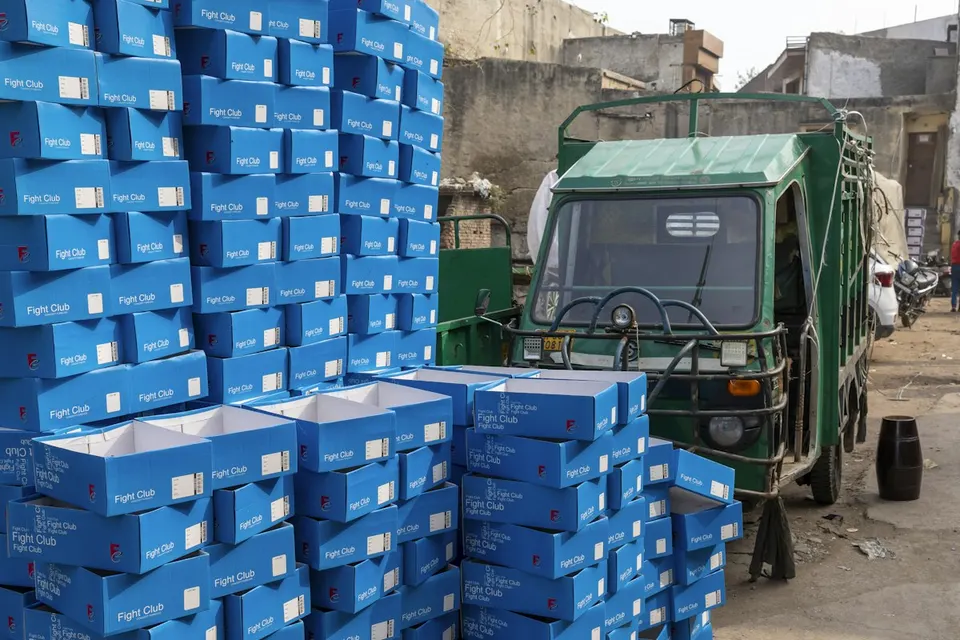
An e-way bill is an electronic document generated on the GST e-way bill portal (ewaybillgst.gov.in) before goods worth more than ₹50,000 are moved by road, rail, air or ship. Required under Section 68 of the CGST Act and Rule 138 of the CGST Rules, it records the invoice, the supplier, the recipient and the vehicle, and it has a 12-digit number that officers can check in transit.
If you sell goods anywhere in India and send them out in a truck, tempo or courier van, you will run into the e-way bill sooner or later. It is the GST system's way of tracking goods on the road, and missing one can get a vehicle stopped and the goods held until a penalty is paid. This guide explains what an e-way bill is, why it exists, who has to generate it and what it contains, so you can handle it confidently.
What is an e-way bill under GST?
An e-way bill (electronic way bill) is a document generated online on the government's E-Way Bill System, run at ewaybillgst.gov.in, before goods start moving. The legal basis is Section 68 of the CGST Act, 2017, which lets the government require documents for goods in transit, and Rule 138 of the CGST Rules, 2017, which sets out the e-way bill itself in Form GST EWB-01.
Once generated, each e-way bill gets a unique 12-digit e-way bill number (EBN). That number is shared with the supplier, the recipient and the transporter. A tax officer stopping a vehicle can check it on a mobile device or by scanning the QR code on the printout, so there is no need for paper check posts at state borders.
Put simply: the invoice tells the tax department what was sold; the e-way bill tells it that those goods are on the move, in which vehicle, from where to where.
Why did India introduce the e-way bill?
Before GST, many states ran their own road permits and border check posts, and trucks often waited for hours at state lines. The national e-way bill replaced these with one online system that works the same way across the country. Inter-state e-way bills became mandatory from 1 April 2018, and intra-state e-way bills were phased in by the states shortly after.
The system serves three practical purposes:
- Tracking goods against invoices. Data from the e-way bill can be compared with the outward supplies you report in your GSTR-1, making it harder to move goods "off the books".
- Faster movement. Officers verify an e-way bill electronically instead of inspecting every lorry at a border.
- One system for everybody. Suppliers, buyers and transporters all work from the same record, which reduces disputes about what was sent.
When is an e-way bill required?
The core rule is the value threshold. An e-way bill is required when goods are moved and the consignment value exceeds ₹50,000. "Consignment value" is the value declared on the invoice, bill of supply or delivery challan, including GST (CGST, SGST/UTGST, IGST and cess) but excluding the value of exempt goods billed on the same invoice.
The movement can be for any of these reasons, not just a sale:
- a supply (sale, transfer between branches, barter or exchange)
- a reason other than supply, such as sending goods for job work, returning goods, or sending samples on approval
- an inward supply from an unregistered person
There are important exceptions where you need an e-way bill even below ₹50,000 — for example goods sent by a principal to a job worker in another state, and inter-state movement of notified handicraft goods by a person exempt from registration. These are covered in our guides on e-way bill limits and rules and e-way bills for job work.
Some states set a different threshold or conditions for movement within the state. Always check your own state's rule for intra-state transport.
Who has to generate the e-way bill?
The person "causing the movement" is responsible. The table below summarises who usually generates it.
| Situation | Who generates the e-way bill |
|---|---|
| Registered supplier sends goods in own or hired vehicle | Supplier (consignor) |
| Registered buyer arranges transport and collects from supplier | Buyer (consignee) can generate |
| Supplier hands goods to a transporter without generating it | Transporter, on the basis of the documents given |
| Unregistered supplier sells to a registered buyer | Registered buyer is responsible |
| E-commerce operator or courier moving goods for a seller | May generate on the seller's behalf where permitted |
| Unregistered person moving own goods | Can enrol as a citizen and generate |
Even when the transporter generates it, the supplier remains liable if goods move without one. It is safest for the business that issues the invoice to make sure the e-way bill exists before the truck leaves.
What details does an e-way bill contain?
Form EWB-01 is split into two parts. You can read the full field-by-field breakdown in our guide to Part A and Part B of the e-way bill; here is the summary.
Part A — the goods and the transaction
- GSTIN of the supplier and of the recipient (or "URP" for an unregistered person)
- place of dispatch and place of delivery (PIN codes)
- document type, number and date (tax invoice, bill of supply, delivery challan, bill of entry)
- value of goods and tax amounts
- HSN code of the goods
- reason for transport (supply, job work, export, line sales and so on)
- transport document number, if any (lorry receipt, railway receipt, airway bill)
Part B — the vehicle
- vehicle number for road transport, or
- transport document number for rail, air or ship
Part A can be filled by the supplier, buyer or transporter. Part B is normally filled by whoever actually arranges the vehicle. An e-way bill without Part B is not valid for movement, except for short movements within a state of up to 50 km between the consignor's place and the transporter's place (and likewise from the transporter to the consignee).
How long is an e-way bill valid?
Validity depends on distance. Since 1 January 2021 (Notification 94/2020-Central Tax), rule 138(10) gives:
| Type of cargo | Distance | Validity |
|---|---|---|
| Normal cargo | Up to 200 km | 1 day |
| Normal cargo | Each further 200 km or part | 1 more day |
| Over-dimensional cargo | Up to 20 km | 1 day |
| Over-dimensional cargo | Each further 20 km or part | 1 more day |
A "day" runs from the time of generation to midnight of the following day. Our e-way bill validity guide walks through the calculation with dates and times.
Worked example: does this consignment need an e-way bill?
A Pune hardware shop sells hand tools to a contractor in Nashik. The invoice shows:
| Item | Amount |
|---|---|
| Taxable value of tools | ₹45,000.00 |
| CGST @ 9% | ₹4,050.00 |
| SGST @ 9% | ₹4,050.00 |
| Invoice total | ₹53,100.00 |
The taxable value alone is below ₹50,000, but the consignment value includes GST. ₹53,100 is above ₹50,000, so an e-way bill is needed. (Pune to Nashik is an intra-state movement within Maharashtra, so the shop should also confirm the state's intra-state rule, which can differ from the central threshold.)
Now suppose the same contractor orders ₹40,000 of tools plus ₹15,000 of an exempt item on one invoice. Tax on the tools at 18% is ₹7,200, making the taxable portion ₹47,200. Exempt goods are excluded from consignment value, so the figure that counts is ₹47,200 — below the threshold, and no e-way bill is needed under the general rule.
If you want to double-check the tax figures before invoicing, the GST calculator does the arithmetic for you.
When is an e-way bill not required?
Rule 138(14) lists situations where no e-way bill is needed regardless of value. The common ones include:
- goods specified in the annexure to rule 138, such as LPG for household supply, kerosene sold under PDS, postal baggage, jewellery, currency, and used personal and household effects
- goods carried in a non-motorised conveyance (for example a hand cart)
- goods moved from a port, airport, air cargo complex or land customs station to an inland container depot or container freight station for customs clearance
- goods moved under customs supervision or customs seal
- empty cargo containers
- goods moved up to 20 km from the consignor's place to a weighbridge and back, within the state, with a delivery challan
- movement of goods by defence formations under the Ministry of Defence
- goods exempt from GST by notification, and goods treated as "no supply" under Schedule III
Some states also exempt specific goods or areas for intra-state movement. Check your state notification if you rely on a local exemption.
How do you generate an e-way bill?
You can generate one on the portal, by SMS, through the mobile app, by bulk JSON upload, or directly from your billing software through API integration. The usual portal steps are:
- Log in to ewaybillgst.gov.in with your GSTIN-linked username and complete two-factor authentication (mandatory for taxpayers and transporters since 1 April 2025, per the portal's notice).
- Choose e-Waybill → Generate New.
- Fill Part A from your invoice: document details, parties, items with HSN, values and tax.
- Fill Part B with the vehicle number, or enter the transporter ID so the transporter can fill it.
- Submit. The system shows the 12-digit e-way bill number and a printable form with a QR code.
Our step-by-step guide on how to generate an e-way bill covers each method, including bulk and API. Note that the portal only allows e-way bills for documents dated within the last 180 days, a restriction GSTN announced from 1 January 2025.
What can you do with an e-way bill after generating it?
The e-way bill is not frozen once created. Depending on the situation you can:
- Update Part B if the vehicle changes mid-journey or goods are transhipped.
- Cancel it within 24 hours of generation if the goods did not move or were not moved as declared, provided an officer has not verified it. See how to cancel an e-way bill.
- Extend validity within a window of 8 hours before to 8 hours after expiry if the goods are delayed. See extending e-way bill validity.
- Consolidate several e-way bills travelling in one vehicle into a consolidated e-way bill (Form EWB-02).
- Accept or reject an e-way bill raised against your GSTIN as recipient. If you do neither within 72 hours of generation or delivery (whichever is earlier), it is treated as accepted.
Common mistakes with e-way bills
- Leaving GST out of the value. The ₹50,000 test uses the value including tax. Many shops check only the taxable value and wrongly skip the e-way bill.
- Forgetting Part B. A Part A slip alone does not allow movement beyond the 50 km local exception.
- Wrong vehicle number. A typing mistake in the vehicle number can be treated as goods moving without a valid document. Fix it with "Update Part B" before dispatch.
- Splitting invoices to dodge the threshold. Splitting one sale into several sub-₹50,000 invoices on the same day for the same buyer invites scrutiny and penalties.
- Ignoring blocking. Rule 138E allows the portal to block e-way bill generation for a GSTIN that has not filed its returns for the period specified in that rule. File GSTR-3B on time or you may suddenly be unable to dispatch goods.
- Using a mismatched GSTIN. Validate the recipient's GSTIN before invoicing; the GSTIN validator is a quick way to check the format.
How billing software makes e-way bills easier
Most e-way bill errors happen when someone retypes invoice data into the portal. If your invoicing tool can create the e-way bill directly from the invoice, the HSN codes, values, tax and GSTINs flow across without re-entry. Billing Software by Betterwork, for example, generates e-invoice IRNs and e-way bills from the same invoice record, so the document number and values match what you report in your returns.
Key takeaways
- An e-way bill is an electronic movement document in Form GST EWB-01, generated on ewaybillgst.gov.in under Section 68 and Rule 138.
- The general trigger is a consignment value above ₹50,000, including GST but excluding exempt goods.
- Some movements need one regardless of value, such as inter-state job work and notified handicraft goods.
- Part A holds invoice and goods details; Part B holds the vehicle. Both are needed for most movements.
- Validity is one day per 200 km for normal cargo and one day per 20 km for over-dimensional cargo.
- Moving goods without a valid e-way bill can lead to detention and a penalty under Section 129.
This guide is general information, not tax advice. Rules last checked on 20 October 2026; confirm with your tax professional for your situation.