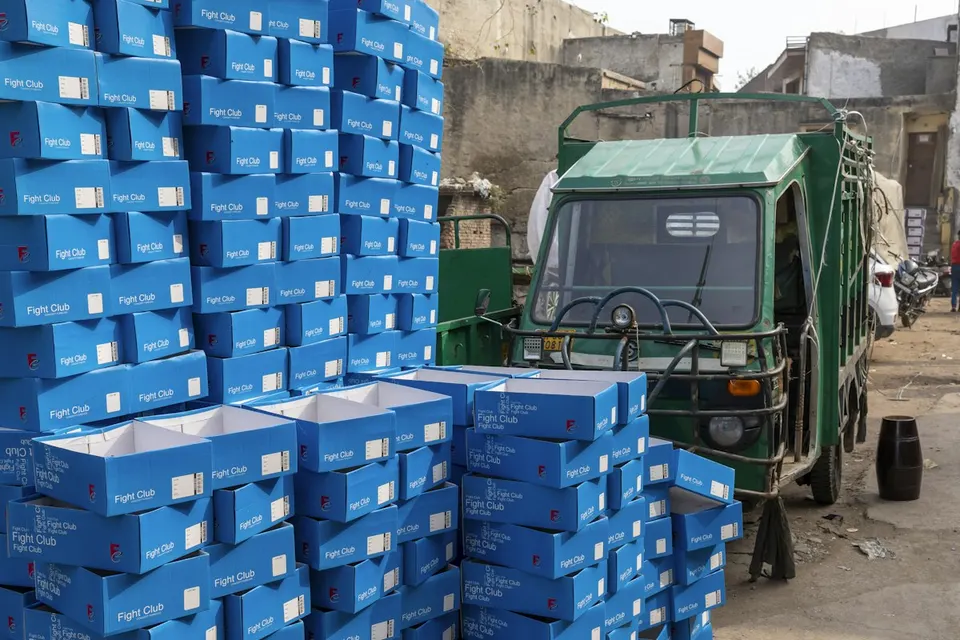
If goods move without a valid e-way bill, officers can detain the vehicle and goods under Section 129 of the CGST Act. Release requires a penalty of 200% of the tax payable if the owner comes forward, or the higher of 50% of goods value and 200% of tax if not. For exempt goods it is 2% or 5% of value, capped at ₹25,000. Section 122 adds a ₹10,000 or tax-evaded penalty.
An e-way bill takes a few minutes to generate. Not having one, or having one that is wrong or expired, can cost twice the tax on the whole consignment and keep a truck off the road for days. This guide explains which provisions apply, how the penalty is worked out, what happens during an inspection, and how to avoid the most common triggers.
If you are unsure whether your consignment needs an e-way bill, see e-way bill limit and rules.
What are the legal provisions behind e-way bill penalties?
| Provision | What it covers |
|---|---|
| Section 68, CGST Act | Requires the person in charge of a conveyance to carry prescribed documents (the e-way bill) |
| Rule 138A | Documents to carry: invoice/bill of supply/challan and the e-way bill (physical or electronic) |
| Rule 138B, 138C | Verification of documents and inspection of conveyances; officer's reports in Form EWB-03 |
| Rule 138D | Transporter's report of detention beyond 30 minutes in Form EWB-04 |
| Section 129 | Detention, seizure and release of goods and conveyances in transit, with penalty |
| Section 129(6) | Sale or disposal of detained goods or conveyance if the penalty is not paid within 15 days of the order |
| Section 122 | General penalties, including transporting taxable goods without the required documents |
| Section 125 | General penalty for contraventions where no separate penalty is provided |
How much is the penalty under Section 129?
After the amendment by the Finance Act, 2021 (effective 1 January 2022), Section 129 is a pure penalty provision — tax is dealt with separately — and the release amounts are:
| Situation | Taxable goods | Exempt goods |
|---|---|---|
| Owner of goods comes forward | 200% of the tax payable | 2% of value or ₹25,000, whichever is less |
| Owner does not come forward | 50% of value or 200% of tax, whichever is higher | 5% of value or ₹25,000, whichever is less |
Goods can also be released on furnishing a security equal to this amount in the prescribed manner.
Note the jump when the owner does not come forward: 50% of the value of goods can be many times the tax.
Worked example: penalty on a missing e-way bill
A Ghaziabad electrical goods trader sends cables to a contractor in Dehradun without an e-way bill.
| Item | Amount |
|---|---|
| Taxable value | ₹1,50,000.00 |
| IGST @ 18% | ₹27,000.00 |
| Invoice value | ₹1,77,000.00 |
The vehicle is stopped and the goods detained.
Case A — the trader comes forward: Penalty = 200% × ₹27,000 = ₹54,000.
Case B — nobody claims ownership:
- 50% of value of goods = 50% × ₹1,50,000 = ₹75,000
- 200% of tax = ₹54,000
- Higher of the two = ₹75,000
(Here "value" is taken as the taxable value; how value is determined in a specific case is a matter for the officer's order.)
Compare that with generating an e-way bill, which costs nothing. Even a single detention typically costs more than years of careful compliance.
Exempt goods example
A Nashik farm produce dealer moves exempt goods worth ₹6,00,000 in a case where an e-way bill was required by the state's rule but not generated.
- Owner comes forward: 2% × ₹6,00,000 = ₹12,000, which is less than ₹25,000 → ₹12,000
- Owner does not come forward: 5% × ₹6,00,000 = ₹30,000; capped at ₹25,000
What is the penalty under Section 122?
Separately from detention, Section 122(1) lists offences by a taxable person, including transporting taxable goods without the documents required by the Act. The penalty is ₹10,000 or the tax evaded, whichever is higher. In practice, detention cases are usually resolved under Section 129, but the general penalty provision exists alongside it.
What counts as "moving without a valid e-way bill"?
The obvious case is no e-way bill at all. But detention can also follow when:
- The e-way bill has expired and was not extended — see extend e-way bill validity.
- Part B is missing for a journey that needed it, or the vehicle number does not match the vehicle carrying the goods — see Part A and Part B.
- The quantity or description of goods does not match the e-way bill and invoice.
- The e-way bill was generated after the goods began moving.
- One e-way bill is reused for multiple trips.
- The e-way bill was generated against an invoice that does not exist or has a different value.
Which errors should not lead to detention?
CBIC Circular No. 64/38/2018-GST says that proceedings under Section 129 should not be started for minor errors in the e-way bill, giving examples such as:
- spelling mistakes in the name of the consignor or consignee, where the GSTIN is correct
- an error in the PIN code that does not result in increased validity
- an error in the address of the consignee to the extent that the locality and other details are correct
- one or two digits of the document number mentioned wrongly
- an error in four- or six-digit level HSN where the first two digits are correct and the rate of tax is correctly mentioned
- one or two digits or characters of the vehicle number mentioned wrongly
In such cases a penalty of ₹500 each under the CGST and SGST Acts (or ₹1,000 under the IGST Act) may be imposed under Section 125 instead. This is no excuse for carelessness, but it shows that a typing error is treated very differently from no e-way bill.
What happens during an e-way bill inspection?
- Interception. A proper officer stops the vehicle and asks for the documents. The driver shows the invoice or challan and the e-way bill (printout, number or on phone). The officer can verify using the e-way bill number or QR code.
- Part A of Form EWB-03. If the officer physically inspects the goods, a summary report is recorded online within 24 hours of inspection.
- Final report. The final report in Part B of Form EWB-03 is recorded within 3 days of inspection.
- No repeated checks. Once physical verification is done in a state, it is not repeated in the same state for the same consignment unless there is specific information of evasion.
- Detention. If documents are not in order, the officer issues an order of detention in Form GST MOV-06 and a notice specifying the penalty.
- Release. Goods are released on payment of the penalty or furnishing security.
- Non-payment. If the penalty is not paid within 15 days of the order, the goods or conveyance become liable to be sold or disposed of under Section 129(6) to recover it.
If the vehicle is held for more than 30 minutes, the transporter can upload Form EWB-04 on the portal. The official FAQ explains that this report reaches the designated officer immediately so that action can be taken.
Other consequences beyond the penalty
- Blocking of e-way bill generation (rule 138E). A separate risk: if your GSTR-3B (or, for composition taxpayers, the relevant return/statement) is not filed for the period specified in rule 138E, the portal can block your GSTIN from generating e-way bills until you file.
- Scrutiny of returns. Mismatches between e-way bills, e-invoices and GSTR-1 can lead to notices.
- Business disruption. Detained goods mean delayed deliveries and unhappy customers, often costing more than the penalty.
How to avoid e-way bill penalties: a checklist
- Test the threshold on tax-inclusive value before every dispatch.
- Generate before the vehicle leaves, not after.
- Fill Part B with the right vehicle number; update it on every transhipment.
- Check validity on long trips and extend within the 8-hour window if delayed.
- Match quantity and description exactly to the invoice or challan.
- Carry the invoice/challan with the e-way bill number.
- File returns on time so generation is never blocked.
- Validate GSTINs using the GSTIN validator before invoicing.
Can you appeal against an e-way bill penalty?
Yes. An order passed under Section 129 is an appealable decision. A taxpayer who disagrees can file an appeal to the Appellate Authority in Form GST APL-01 within the time allowed under Section 107. Payment of the penalty to secure release of the goods does not by itself take away the right to appeal, but you should take professional advice on the conditions and pre-deposit that apply in your case.
What to do if your vehicle is stopped: a practical sequence
- Stay calm and show everything at once. The driver should hand over the invoice or challan and the e-way bill number together. Missing papers that are actually in the office can often be shared on a phone.
- Check the officer's paperwork. Proceedings should be recorded in the prescribed forms, and the penalty must be specified in a notice and order. Keep copies or photos of everything issued.
- Inform the owner of goods immediately. The supplier or buyer, not the driver, usually decides whether to pay, furnish security or contest. Whether the owner comes forward also changes the penalty formula under Section 129.
- Diagnose the problem honestly. Was the e-way bill missing, expired, or just carrying a clerical error of the kind listed in Circular 64/38/2018-GST? The answer decides which provision is relevant.
- Respond within the time limits. Section 129 gives a short window for payment after the order. Diary the dates the same day.
- Fix the root cause. After release, find out why the gap happened — a missed threshold check, an unupdated Part B or an expired bill — and change the dispatch routine.
Common mistakes that lead to e-way bill penalties
- Treating the ₹50,000 limit as taxable value only, so tax-inclusive values just above the limit go uncovered.
- Assuming the transporter will generate the e-way bill when the supplier has not asked them to.
- Letting an e-way bill lapse while a truck waits at a hub.
- Sending inter-state job-work goods below ₹50,000 without an e-way bill — see e-way bill for job work.
- Using one e-way bill for several trips, or for goods added after generation.
Generating the e-way bill from the same record as the invoice, as Billing Software by Betterwork does, keeps values, HSN and GSTINs consistent — which removes many of the mismatches that start an inspection.
Key takeaways
- Section 129 penalty for taxable goods: 200% of tax if the owner comes forward; the higher of 50% of value and 200% of tax if not.
- For exempt goods: 2% (or 5%) of value, capped at ₹25,000.
- Section 122 provides a general penalty of ₹10,000 or tax evaded, whichever is higher.
- Minor clerical errors should not lead to detention per Circular 64/38/2018-GST; a smaller Section 125 penalty may apply.
- Penalties unpaid 15 days after the order make the goods or vehicle liable to sale under Section 129(6).
This guide is general information, not tax advice. Rules last checked on 20 October 2026; confirm with your tax professional for your situation.